
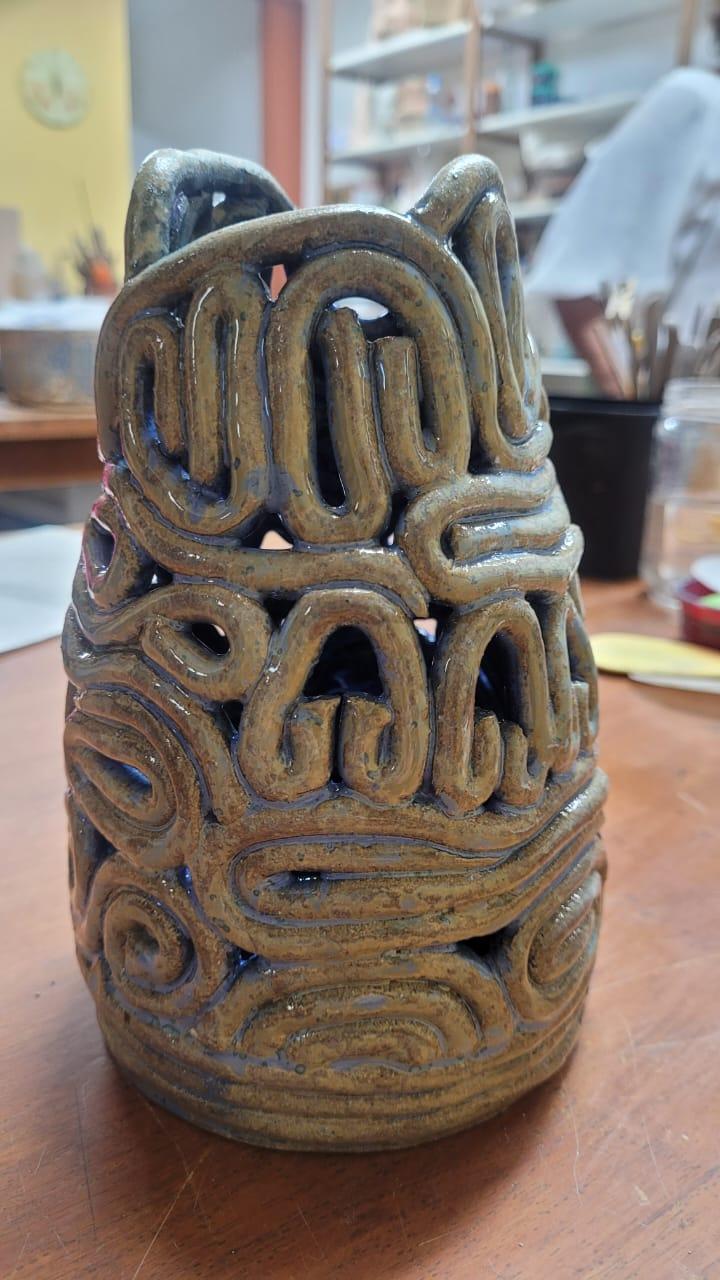
Inspired by the Japanese coil-building technique, this vase was built by hand, layer by layer.
The idea came up in the studio of my teacher, Magali Ercolin. One day she showed me a book written entirely in Japanese. I could not understand a single word, but I was captivated by the images.
The book showed ceramics from the Jōmon period, an ancestral Japanese style that goes back more than 10,000 years. The pieces had free, intertwined forms, almost alive.
Jōmon ceramics are made with coils of clay, rising layer by layer. They do not follow rigid patterns. Each piece grows according to the gesture of the person shaping it.
When I began modeling this vase, I realized I needed patience. Each line had to respect the one before it. I redid some parts, waited for them to dry, and continued later.
During the process I chose a glaze that would flow into the grooves and reveal the marks of the hand-building.
In the end this piece emerged. I named it Interlaces, because that was the feeling I had while working: clay, time, and gesture meeting each other.


Interlaces — 縄文の手 (Jōmon no Te)
Built layer by layer, with time and attention.
Japanese inspirations
- 手びねり (Tebineri) — hand-building without a wheel
- 積み上げる (Tsumiageru) — building layer by layer
- 間 (Ma) — the space between actions
- 侘寂 (Wabi-sabi) — the beauty of imperfection
- 気配 (Kehai) — subtle presence